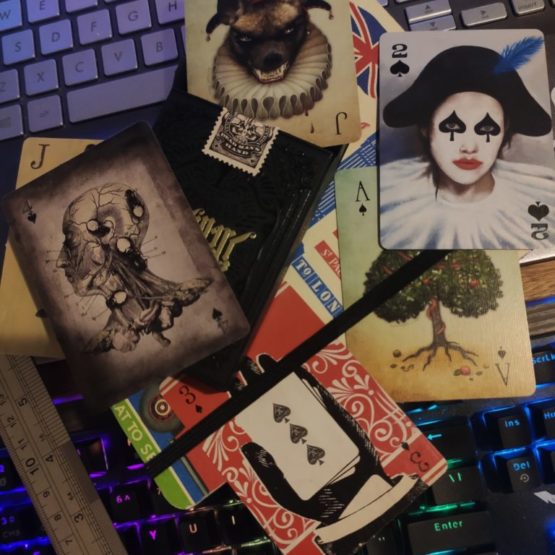
I like (am obsessed with) playing cards. I have said this before, I don’t know that I recall what came first magic or cards… Doesn’t really matter, I guess. I really like playing cards and I really like magic. The “pick a card” kind, not the “I am going to have you possessed by the spawn of my demon child” kind. The latter might come in handier than being able to guess someone’s card, but it’s so messy. You need cauldrons and the toe nails of the pope’s bastard son…
One of the things I have been playing with lately is stacks. That is the concept of being able to perform certain feats by virtue of knowing the order the cards are in. That sounds simple enough but it’s goddamn hard! In order to not have a spectator cotton on to the fact that the card are in a specific order, you have to make that order hard to recognize. So no, red-black-red-black-red-black. Or all the odd cards on one side and the even cards on the other. Actually, that may work… never mind. Problematically the harder you make it for a spectator to figure out, the harder it becomes for you to remember. Here is a random part of a stack I am trying to commit to memory at the moment: 6S, KS, 9H, 2S, 3C, 6H 10H, 4S, JD
See, there is no discernable pattern there. And there is 43 more where that came from. Granted there are quite a few magic effects created that require a stack but don’t require the performer to memorize it. That same stack I am studying now has two royal flushes built into it and you would never notice. All I have to do is remember where they start and how many hands to deal (The royal flush in hearts is for a 4- and the one in spades is for a 5-handed game). There comes a point though that you would want to use that stack for the ultimate trick. You think, just think of a card. You tell me what it is, I shuffle and *BOOM* your card is at the top. To do that I need to know the location of all 52 cards.
And I suck at remembering things! There are certain facts that I can easily remember… The fact that three out of four nines in this particular stack are preceded by a two. Great! But they are not the same number of cards apart and because I don’t know that distance, it doesn’t help me. No, there comes a point where I just have to commit this to memory. But how? I have been starting at these cards for a week and didn’t get much further than knowing that the JS is the first card. What we need here is mnemonics!
Luckily I stumbled upon a 2014 book by Geoff Williams. It’s called “The Aronson Stack For Everybody” – There, now you finally know what card-order I have been talking about. Simon Aronson devised this stack sometime in the 1970s (Geoff says 1976) a short time before Juan Tamariz came up with the infamous (among people into card tricks anyway) Mnemonica stack. Which, incidentally isn’t any easier to memorize than the Aronson stack, despite its name…
Geoff, in his book, describes a simple mnemonics system to more easily memorize the order of the cards. It isn’t particularly revolutionary but it was designed specifically around memorizing cards and the Aronson stack in particular. And in 70-odd pages he does a brilliant job of putting you well on your way to doing the impossible — Memorizing 52 cards in seemingly random order. Given that a large portion of the essay is dedicated to actual pictures of the mnemonic “peg words” he came up with (and some of them are truly nightmare inducing) this is about the quickest introduction to memory systems you can hope to find.
So how does it work?
For each card in the deck there are 2 word. One word describes the position in the stack, the other the value and suit of the card. The first card in the stack, “TOE JET” is the jack of spades. The practice and study aids in the book all use Geoff’s list of words, but you can come up with your own (as I did) if certain words don’t resonate with you. As Williams describes, it’s your brain! It needs to work for you!
You assign consonants to numbers and use these to represent numbers/positions in the deck. Single digits get one consonant, and double digit numbers get 2. T stands for one, N stands for 2, M stands for 3, R for 4. You now add vowels to make a word. For single digit numbers there is no second consonant and that is how the first card of the deck is “Toe”. This is followed by No, Me, Ray, Eel, Goo, Key, Fay, Pee – And there you have 1 through 9.
In Geoff’s book “No” was “Knee”. I found this to be extremely confusing. K is the letter that represents 7, but appears in the peg word as a silent letter for 3 values — Knee (2) , Knob (29), Knife (28). I replaced these with No, Nap and Naff. All these break Geoff’s rule that peg words need to be a tangible object.
Numbers and Letters
Now you have the places in the deck, you do the same for value and suit. The letters for values are T=1, N=2, M=3, R, L, G, K, F, P, S, J=Jack and H=Queen. That’s one through 12. The king is simply represented by its suit. So the king of spades is simply “SPADE”. Suits are T=Spades, N=Hearts, M, Clubs and R = Diamonds. For each card you take the consonant for value and the one for suit and make up a word with those. Ace of spades thusly becomes: Ace = 1 = T, Spades = 1 = T, combined this becomes TT. make a simple word with that and you might get “tit”. If body ink instead of a vulgar word for a woman’s breast is more your thing, you could use “tat”. If you are into Egyptian history, perhaps “tut”. The ace of spades in the Aronson stack sits in position 6 in the deck… “Goo Tit”
Each card gets two words. “Mom Jam” is the jack of clubs in position 33. 3 = M, so MM for 33. J for jack and M for clubs. With the letter combination MM JM you get “Mom Jam” but it could equally be “Mime Jim”. A few more… Nap rain, Man Sore, Mug Jar, Muff Sin, Tag Foam, Tick Mat.
Bit weird, huh?
There are a few oddities with the suggestions from “The Aronson Stack For Everybody”. I already mentioned the use of the silent K. I replaced all those words. Nap used to be Knob (29). That also had the issue of being the only word using a B instead of a P for 9. Nap, removing that silent K also removes the need to memorize an exception to P = 9. The book also uses K and C interchangeably because, as the author argues, they sound the same. I guess Geoff has never traveled to Cincinnati or used cinnamon in his baking. I just write all words starting with a C with a K instead… Because that’s what the kool kids do. I left words ending in CK alone.
Lastly I replaced most words that had multiple syllables in the original essay.
Does it work?
This is most definitely better than trying to brute force memorizing things. Within a few days of playing with the peg words I am really beginning to see a big difference in being able to memorize portions of the stack. I am nowhere near proficient, but I can get (however slowly) to a card value from a stack position or to a stack position from a card value for about half of the deck. There are still word combos that just don’t work well for me. “Nose Light” (Position 20 – 5 of spades) Just doesn’t want to come to me… But overall the method in Geoff’s book has been a great help. And to think this has been around since 2014. Goo tit see for yourself!